Showing posts with label reviews. Show all posts

Sunday, April 20, 2008

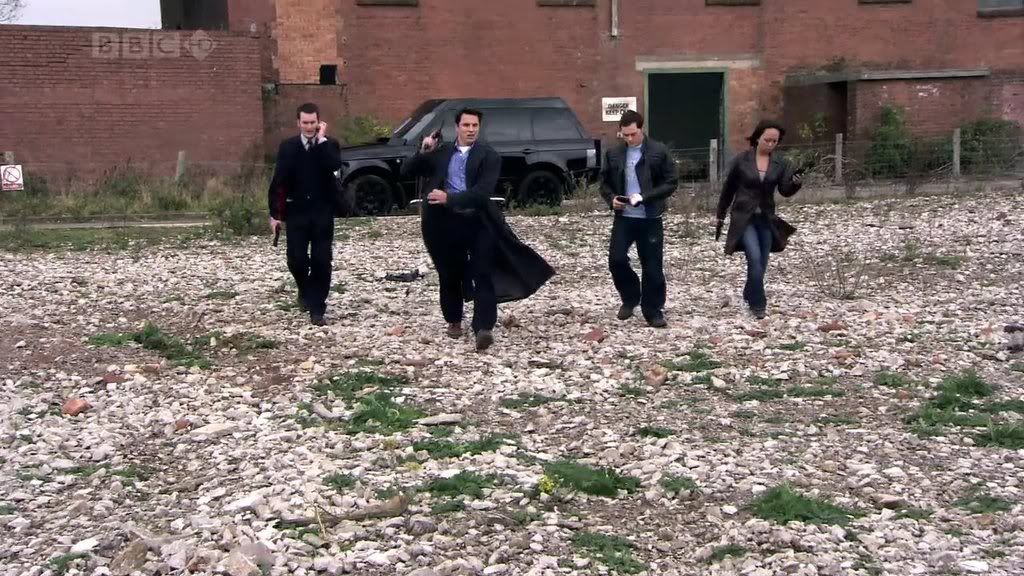
Torchwood 2.13: Exit Wounds

Given its ratings success, there's every indication that Torchwood will be returning for a third season. But writer-producer Chris Chibnall's superlative "Exit Wounds" is something unexpected: a wholly complete and satisfying episode that could just as easily serve as a series finale as a bridge to the third season.

This episode is one of the finest hours of television you're likely to see. Read the rest over at The House Next Door.

Tuesday, April 15, 2008

Torchwood 2.12: Fragments

Chris Chibnall puts that old chestnut, your life flashing before your eyes just before you die, to good use in "Fragments," managing to avoid most of the clumsiness inherent in the typical origin story. It doesn't sit well that we're finally learning how Jack (John Barrowman) built his team just as it appears we're about to lose them all. "Fragments" is satisfying in that it answers many questions about our Torchwood Team, but ultimately it suffers from being nothing more than an extended setup for Chibnall's pull-out-the-stops season finale.

Read the rest over at The House Next Door.

Update: The episode's title has been corrected to "Fragments." Ross kindly pointed out that "Fractures" was a Farscape episode, so I didn't make up the other title out of whole cloth! What a week.

Tuesday, April 08, 2008

Torchwood 2.11: Adrift

There are no aliens in Cardiff this week, but that shouldn't make us complacent. Series co-producer Chris Chibnall brings us back to Torchwood's bread and butter topic: the intersection of the human and the alien, and what it means to be human in the aftermath. Love and loss are common enough partners, but there's no trace of the maudlin here. The themes of hope and loss, two faces of love, are explored with heart-wrenching results.

Nearly brilliant, so close as to make no difference. Read the rest at The House Next Door.

Tuesday, April 01, 2008

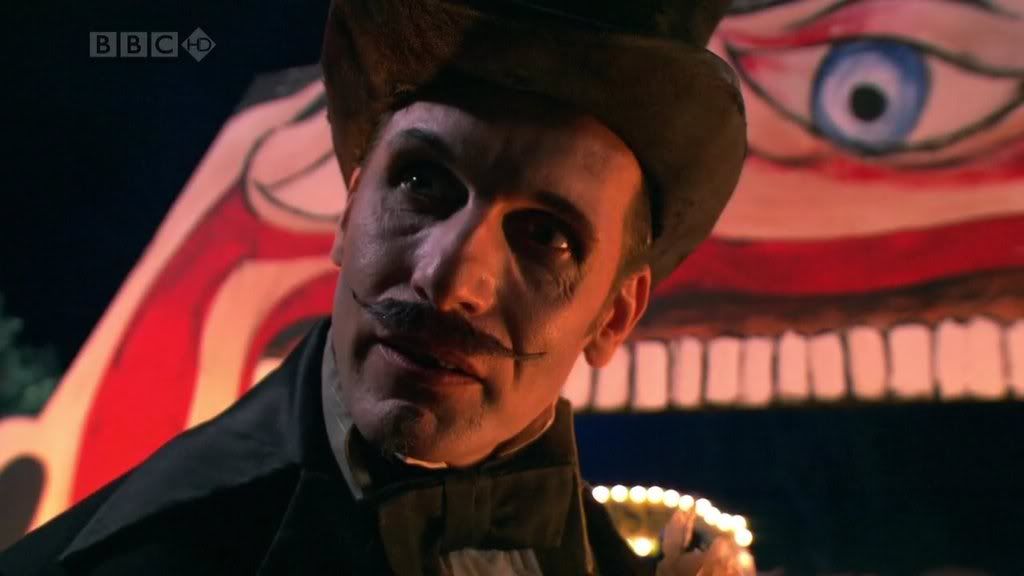
Torchwood 2.10: From Out of the Rain

"From Out of the Rain" was so reminiscent of Season One's "Small Worlds" that it came as no surprise that it, too, was written by Peter Hammond. Like Hammond's inaugural episode, "From Out of the Rain" is atmospheric and creepy, and reaches back into history both personal and cultural. But where "Small Worlds" grappled with a well-known archetype, here we're dealing with something almost unrecognizable: a traveling sideshow that appears out of nowhere to abduct and murder. It was OK that we never got much of an explanation about the fairy elementals, but it's frustrating here that we never learn anything about the creatures that terrorize Cardiff. Well, not quite; even worse than the lack explanation is the curious lack of menace. "Small Worlds" worked, in part, because we knew that the elementals had the power to destroy everything. Both urgency and momentum are lacking, here; without that existential threat, there's little to engage beyond nostalgia.

Click here to read the rest at the House Next Door.

Thursday, March 27, 2008

Torchwood 2.9: Something Borrowed

One of the sweetest scenes of the season-opening Kiss Kiss Bang Bang was Gwen (Eve Myles), wide-eyed, explaining to Jack (John Barrowman) that the ring she was wearing was an engagement ring. Rhys (Kai Owen) had asked, and she'd said yes, because "Nobody else will have me." Throughout the season the writing team has done a good job of referring to the wedding without making too big a deal of it, which was a very good thing. Anyone who has ever been married or planned a wedding knows how the process can take over your life; the problem is, the details you're obsessing over are deathly boring to the rest of the world. "Something Borrowed," a wedding episode, Torchwood-style, avoids both the precious and the obnoxious, with shape-shifting aliens, tons of snappy dialog, and terrific action set-pieces; in the end, love and a really, really big gun conquer all.

If you couldn't tell already, I thought this episode was a blast. Read the rest over at The House Next Door.
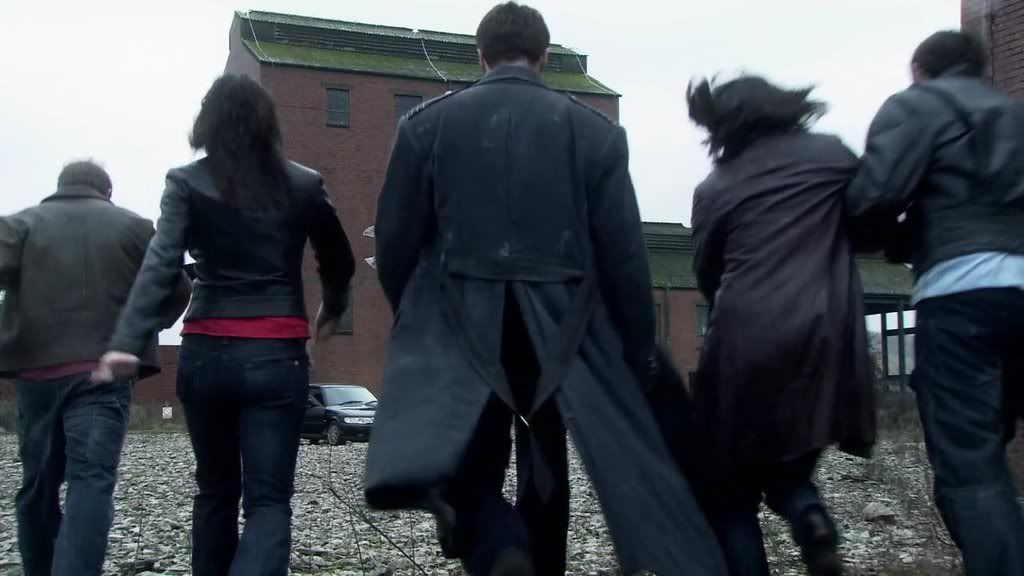
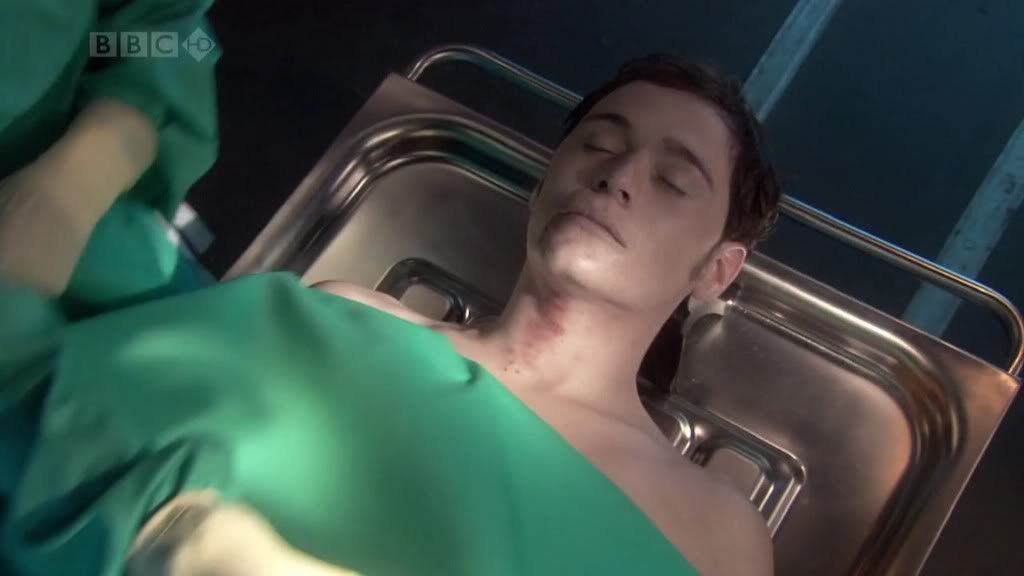
Torchwood 2.8: A Day in the Death

Nothing has really changed by the end of "A Day in the Death," but at least Owen (Burn Gorman) -- still dead -- has found a reason to hope. "A Day in the Death" is the circuitous story of Owen's journey from despair, and the two strangers he meets along the way. It all feels comfortably familiar, but the performances elevate it above cliché, most of the time.

Better late than never, right? It's been up over at The House Next Door for ages.

Sunday, March 09, 2008

Torchwood 2.7: Dead Man Walking

How fondly I recall last week's "Reset," the episode which brought Dr. Martha Jones (Freema Agyema) to Cardiff and unexpectedly killed off Torchwood's resident medical officer, Owen Harper (Burn Gorman). I was worried about whether or not Owen would stay dead, and I was right to be. "Dead Man Walking" oscillates between creepy and campy, and even occasional side jaunts into seriousness can't save it.

At times, I thought this one would topple over into "so bad it's good" territory, but alas, it didn't. Read the rest over at The House Next Door.

Tuesday, March 04, 2008

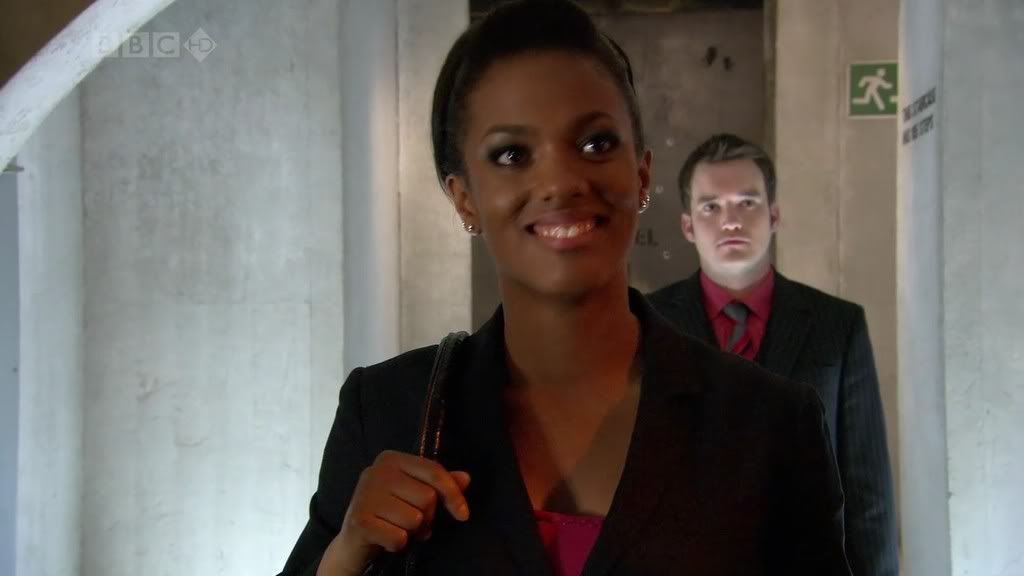
Torchwood 2.6: Reset

Captain Jack Harkness (John Barrowman) first met then-medical student Martha Jones (Freema Agyema) in Doctor Who's third season pre-finale "Utopia," when Jack clung to the exterior of the TARDIS as it raced to the end of time. Luckily, Jack was uniquely qualified to solve the technical problems that were keeping the remnants of humanity from reaching their final home, and it was Jack's wrist jump-unit that got the Doctor and his two companions away in the nick of time in "The Sound of Drums." But it was in "The Last of the Time Lords" that Martha Jones saved the world, and Jack Harkness is one of very few people alive who remembers it. It's a great pleasure, then, when Dr. Jones arrives at Torchwood, where aliens may shuffle in and out, but the monster of the week is nearly always human.

Click here to read the rest over at the House Next Door.

Monday, March 03, 2008

Torchwood 2.5: Adam

Torchwood enters Bizarro World when an alien reprograms the team's memories – and personalities – in "Adam." We're short on science fiction and long on character again this week, as is usual for writer Catherine Tregenna, but we get a big juicy chunk of Captain Jack's backstory. It's up to you whether or not it's a worthy trade. I was happy to hear Gray's story only four episodes after John Hart dropped that bombshell ("I found Gray") on Jack.

Click here to read the rest at the House Next Door.

Monday, February 18, 2008

Torchwood 2.4: Meat

From the beginning, we all knew that former police constable Gwen Cooper (Eve Myles) would someday be forced to choose between her sweetheart Rhys (Kai Owen) and her dashing Torchwood boss Captain Jack Harkness (John Barrowman). In Catherine Tregenna's "Meat," Gwen makes her choice.

While pretty weak on its sci-fi aspects, this episode rocked for its character development. If you've ever wondered what would happen if Rhys went toe-to-toe with Jack, you're about to find out. Read the rest over at The House Next Door.

Friday, May 25, 2007

such times we live in

Over at The House Next Door, a link to a particularly sarcasm-laden review of Pirates of the Caribbean: At World's End led me to comment on the critic's behavior:
If you admit, up front, that you're bored and/or unimpressed with the spectacle, that you went in knowing it would suck, then I'm going to discount you and your review. Don't review PotC:AWE as if it's Bergman -- it's not pretending to be. It's supposed to be big, stupid fun, and I can't tell whether or not it succeeds at that because Lee's attitude is piss-poor from the minute he planted his seat in the theater. You can feel his resentment of this franchise, cluttering up his cineplexes, thwarting his desires that every screen be showing something more worthy.

Further down in the comment thread, we got into a discussion of critics and criticism in general. I've given a lot of thought to this, over several years, and here's how I think about it:
[O]rdinary people don't work as film critics [...] -- it's as simple as that. Your income is tied to your opinions, and your ability to express them, and therefore you're a member of an elite cadre, even if you're not willing to admit it. What percentage of the population do you think is made up of people who support themselves as critics? I'm sure its infinitesimal. Ordinary people go to work and make things (in this, factory workers are not so different from software engineers), or serve others, or a cause (waitresses, cabbies, CPAs, politicians).

But a critic exists only in symbiotic relationship with the industry he critiques, and whether or not he survives is entirely dependent on the goodwill of the audience, and to a certain extent, the industry itself. It's a perilous position, and to survive it you have to convince yourself that you are adding value, providing a service, doing something besides hitching a ride on the back of someone else's hard work. And that gives you an attitude[.]
I'm sure you've noticed how many critics -- not at all of them, but a lot -- can't help telling you how much smarter than everyone else they are? Not explicitly, usually, but they find ways to make sure you know it. That's the attitude I'm talking about. Even the ones that don't have a superior attitude have to believe, by definition, that their opinions are so valuable that a larger audience should read them.

Another commenter jumped all over me for calling critics parasites, and a whole host of other things -- I eventually gave it another try, because I don't think what I'm saying here is inaccurate in the least:
[I] see where criticism, as a whole, fits into society and the economy, what role it plays, and its relevance to the population at large.

In short: it's not all that important. Before you go getting all shirty with me again, think about it. In spite of how silly much of criticism is -- and you have to admit that there's a lot of useless cheer leading masquerading as criticism -- people can still make a living off it. It's awesome. It amazes me, really -- the same way I'm amazed when I get paid for a column. But even though one of my jobs is about the coolest thing I could ever hope to get paid for, I'm not about to start thinking that it has any significance in the grand scheme of things. We're living in an extremely prosperous time, and that allows many of us to get paid for stuff that no one would have dreamed of a couple of generations ago.

You can't seriously mean to argue that criticism exists independent of its target industries. I don't view critics as parasites (although some producers probably do); I used "symbiont" because constructive criticism is useful to target industries, as it shines light on the problems and praises what it gets right.

Am I really so wrong about this? How so?