Showing posts with label review. Show all posts

Sunday, February 10, 2008

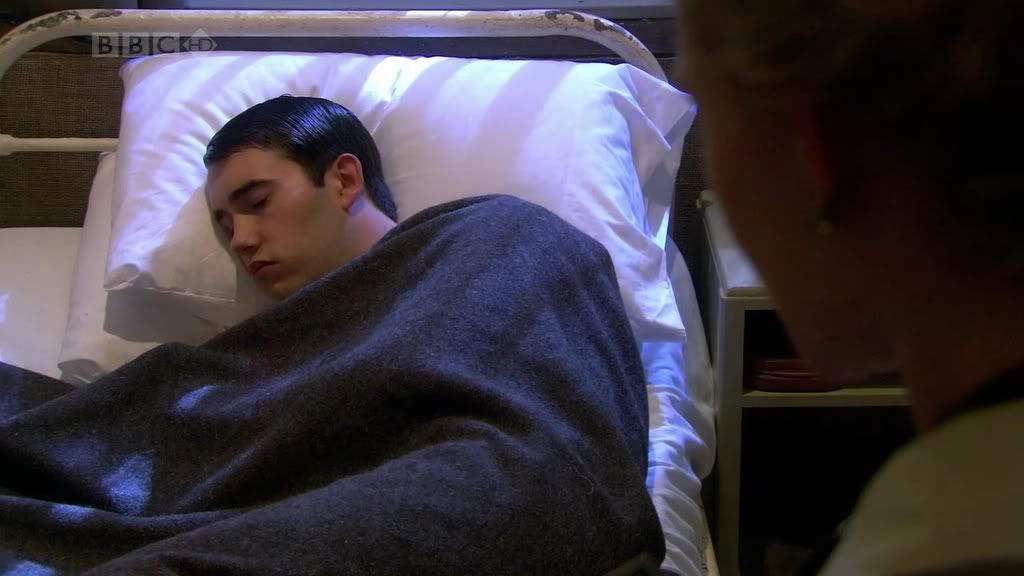
Torchwood 2.3: To the Last Man

Helen Raynor, writer of the solid first season episode Ghost Machine, teams up with Torchwood series creator Russell T. Davies to bring us another kind of ghost story in "To the Last Man." Here, we're haunted by the omnipresent shadow of war, and the vagaries that forge unwitting young men into heroes, and sometimes martyrs to the greater good.

Click here to read the whole thing at the House Next Door.

Sunday, February 03, 2008

Torchwood 2.2: Sleeper


After the entertaining fluff of Kiss Kiss, Bang Bang, Season 2's follow-up effort hits hard. A mash-up of the recurrent themes from Battlestar Galactica and 24, "Sleeper" walks down a checklist of hot-button items, but with grace and feeling, avoids bludgeoning viewers with any particular viewpoint. There's a lot to be said for a show that lets you make up your own mind about how you feel about what's going on.

Click here to read the rest at the House Next Door.

Monday, January 28, 2008

Torchwood 2.1: Kiss Kiss, Bang Bang

When Torchwood's second season debut opens with a cliché-ridden car chase, you can't help but wonder if the show runners are trying too hard. Between-seasons PR promised more team spirit and more fun; what I'm hoping for is a settled sense of, and respect for, the target audience and a lot more consistency with the characterization. "Kiss Kiss, Bang Bang" easily transcends its ridiculous lead-off, and sets the tone for a new season of less bickering, more questions, some answers, and a good mix of otherworldly technology, aliens, sex, and action. It works.

Click here to read the rest at The House Next Door.

Tuesday, December 04, 2007

Torchwood 1.13: End of Days

Following the new Doctor Who's tradition of ending each season with a cataclysmic event, "End of Days" brings Torchwood's premier run to a mostly satisfying conclusion. I could fault writer Chris Chibnall for eliding far too many important details, but there's no need for such a tedious reckoning. What he has given us is an enjoyable combination of characters, alien technology, and an unknowable so far outside our understanding that we want to label it supernatural. Desperate love wreaks havoc, but simple faith can (apparently) repair all.

Read the rest at The House Next Door.

Monday, November 26, 2007

Torchwood 1.12: Captain Jack Harkness

"Out of Time" writer Catherine Tregenna returns with the next chapter in the story of broken-hearted Owen (Burn Gorman). But "Captain Jack Harkness" is not just another story of love gone awry across a rift in time; it gives us a long-overdue glimpse into our Captain Jack's past.

Read the whole thing at The House Next Door.

Monday, November 19, 2007

Torchwood 1.11: Combat

The intersection of the alien and the human is front and center in "Combat," as disaffected young men seek meaning, Fight Club-style. Our Torchwood team regulars struggle to deal with the accumulated consequences of actions we've seen over the course of the season, and Owen (Burn Gorman) becomes the nexus around which everything revolves.

Read the whole thing at The House Next Door.

Tuesday, November 13, 2007

Torchwood 1.10: Out of Time

"Out of Time", gorgeous throughout, ostensibly tells the story of three individuals lost in time thanks to a temporal anomaly caused by the Cardiff Rift. At its heart, it continues Torchwood's nihilistic view of existence. A series that consistently argues that this present reality is all there is while simultaneously featuring a main character with a death wish suffers from both confusion and clinical depression. Ten episodes in, Torchwood still hasn't figured out what it's about, but it appears to be getting closer.

Read the rest at The House Next Door.

Tuesday, November 06, 2007

Torchwood 1.9: "Random Shoes"

"Random Shoes" plays as if an episode of Doctor Who wandered off and got lost, only to find itself somehow on Torchwood. Part police procedural, part ghost story, this episode presents a structural, if not thematic pair to Who's late season two episode, "Love and Monsters.

Read the rest over at the House Next Door.

Monday, October 29, 2007

Torchwood 1.8: "They Keep Killing Suzie"

"They Keep Killing Suzie" is the kind of episode that Torchwood does well: an exploration of the human character, unfolding in unexpected ways in a unique context. It could be seen as a return to form, if Torchwood had established one yet.

There are no aliens in this week's episode, but that doesn't mean that there aren't any monsters; whether they are monsters by nature or nurture is the question of the day.

Read the rest at The House Next Door.

Monday, October 22, 2007

Torchwood 1.7: "Greeks Bearing Gifts"

This week's cautionary tale falls short in spite of its interesting themes and compelling execution. The failure lies in the decision to reduce Toshiko (Naoko Mori) to a lonely, vulnerable mess, unhinging the entire process. Portraying Owen (Burn Gorman) and Gwen (Eve Myles) as idiotic horny teenagers doesn't help. Fortunately Jack (John Barrowman) remains true to his save-the-day character, while Ianto (Gareth David-Lloyd), reverting to his previous status of inscrutable cipher, evokes a three-word response: Seek professional help.

Hey, at least we're back to dealing with aliens this week. Read the rest at The House Next Door.

Sunday, October 21, 2007

Friday Night Lights, 2.2 & 2.3: in spite of themselves

First of all, before I get into details about anything, I have to say that whoever writes the promo spots for NBC should be fired. If possible, the promo staff should be retroactively fired to before this season's episode promos started airing, so we could start over with promos that do not actively turn you off from the shows you formerly loved.

Click here to read the rest.


At this point, anything I'm watching on NBC is in spite of the promos, not because of them. Of course, the only things I'm regularly watching NBC are FNL and Journeyman (more on that later), but the promos spots for these two shows in particular are horrendous. I can just see the thought-process there: What are the most exquisitely painful plot points we can highlight, and how can we make sure everyone knows that their favorite characters are either in peril or miserable, or -- jackpot! -- both?

Seriously, NBC: knock it off, because you're making it harder and harder for me to want to watch these shows, which is a shame because when I finally overcome my promo-based aversion and fire up the TiVO, I adore them just as much as I ever did, if not more. So please, stop it.

2.2 - Bad Ideas
I loved this episode's title, it was so fitting. So many bad ideas, so little time. It seems every single character is caught in a downward spiral this season, the only difference is their relative velocities as they hurtle towards their collective doom. I'm not kidding about that, either -- everyone is in trouble.

The Taylors, together, are struggling with being separated and the feeling that their family is coming apart at the seams. Neither one is over-reacting to the stresses around them, which are considerable. Tami is completely overwhelmed by newborn, cranky Grace, and teenaged, rebellious Julie. The house is a disaster and Julie is not doing anything at all, it seems, to help out. I think it's hard to realize how alone Tami is in Dillon, in spite of the fact that she has a daughter. Her contacts at school are exactly that, school contacts, and she doesn't have another woman friend she can call up and say, "Hey, you can watch Grace for an hour so I can get some shopping done?", or anything else, for that matter. She should be able to leave Grace with Julie, and in fact she should be actively trying to get Julie to engage with her little sister, but Julie is so wrapped up in her own misery right now she's practically unreachable. Of course, if Julie would pitch in at home and help her mom, she might not feel so isolated, but she doesn't see it that way, and reacts (as teenagers typically do) by withdrawing.

When Glen, the science teacher who's covering for Tami while she's on her maternity leave, stops by with a box of files to review with her, he inadvertently becomes Tami's local support system. I don't think he minds, but he does know that he's out of his depth. He was right to ask what Tami was thinking, out walking with Grace in 105 degree heat -- believe me, when the thermometer reads 105, it's a lot hotter on the sidewalk, in the sun, and both mother and daughter were set up for dehydration. Tami should know better -- Tami does know better, but she's not thinking very clearly at the moment. Tami is not at all interested in Glen as a man, but I think it's very possible that Glen has a crush on Tami, even though he'd never do a thing about it, and I loved that he was finally able to get her to admit that living apart from Eric was her idea, and it was a stupid one. I'm relieved that Tami finally asked for help, and I think that it was OK to ask Glen, but I wish she wouldn't stop there -- she needs to keep reaching out and getting support, and as a counselor, she should know that. Isolation is terrible, and having a new baby is tremendously isolating even if you have other kids!

Back to Julie, her attraction to the Swede finally overtakes her impulse to behave decently towards Saracen, which has been waning for some time now; she finally gets up the nerve to give the "it's not you, it's me," speech, but doing it makes her feel worse, not better. She gets over that pretty quickly, though -- only to be patted on the head by the Swede when she sees him at the pool! Sorry, but the Swede is a creep. He knows Julie is only 16 years old and his flirting with her is completely icky. He has to be in his 20s, and he's way too old for Julie, and yet he pursues her. Personally, at this point I think Lois and Saracen should get together, because they've both been badly used by Julie and could bond over that. Plus, Lois seems like a genuinely good girl, as opposed to the brat that Julie is becoming.

Moving onto Saracen, he made his best attempt to keep Julie, and keep her happy, but she had already moved on. He's struggling with the new coach's attitude, and his grandmother is as dotty as ever. Julie dumping him will ultimately turn out to be a good thing for him, I think, as will the arrival of his grandmother's live-in nurse. It's a shame that she's (so far) a stereotype feisty bitch, but she does seem to know what's she talking about regarding the care his grandmother needs. Again, this will, in the long term, turn out to be a good thing for Matt, as he won't have to worry so much about what's going on at home. High school juniors should worry about SATs, grades, and girls, and not whether or not Grandma is bathing at the neighbor's house again. Still, transitions are hard, and Matt has a lot of new situations to accustom himself to.

The Tyra/Landry storyline got stupider, which I did not think possible, with the introduction of the Lost Watch Issue. Stupid, stupid, stupid, but still, it forced the two characters together in an intimate setting, and gave Landry a believable setting in which to finally profess his love for Tyra. Two important things happened then: first, she believed him, and second, she was surprised, because she had never allowed herself to see it. Landry was not that good at hiding his feelings for Tyra, but she was great at not recognizing them for what they were. Now it's all out there. Tyra's subsequent confession to Landry shows what a great couple they are -- he's not sorry he did it and would do it again, for her; she wishes she had done it, both for the satisfaction and to spare him -- and she was equally believable. I liked that Tyra didn't jump into saying she loves Landry, because she doesn't know how she feels about him -- but she knows she feels enough for him to sleep with him, and the way that all works out was pretty much OK.

Jason Street: team mascot, or quarterback coach? Well, since the new coach has such an emphasis on the running game and Smash in particular, Jason isn't left with much to do. But he has new hope since he can make a fist now, something he wasn't able to do before. He's disappointed when the doctor insists, for the nth time, that he won't walk again. One of Jason's rugby teammates tells him about some experimental stem cell surgery they're doing in Mexico (forcibly reminding us of the episode's title.) Later, Jason runs into Tami as she's leaving Glen's office, and tells her that in his recurring dream, she tells him to get up and walk, and he does. He thanks her; Tami is touched but concerned, but Jason is radiantly hopeful.

Lyla's still a Jesus freak, but her prayers become less confident as she watches Tim Riggins macking with a rally girl on the other side of the cafeteria. Riggins is still messing up in practice and calling the coach's wrath down upon himself. The two are brought together when Buddy, Lyla's dad, overdoes it at the pep rally -- moved from his dealership out to a rival booster's ranch -- and collapses in a drunken heap. Riggins helps Lyla get her dad to his generic apartment, and the two share a (non-physical) moment. These two have chemistry, but Lyla knows that going back to Tim would be very, very bad for her, and resists. Tim, for his part, is still in love with her, and I'm not sure what it would take for him to not be.

Coming back around to Coach Taylor, he's struggling in his position at TMU. He's low man on the totem pole, and as such he's assigned the unpleasant task of ferrying an unrepentant player to a hearing on ethics charges. Taylor gives the obnoxious player an earful on how his selfishness and arrogance are letting the team down, but the player scores one on Taylor, asking him what the hell he's doing in Austin when he has a new baby at home in Dillon. Since the player smartens up and sincerely apologizes, and Taylor steps in and says they'll make sure this guy straightens up, the player ends up with only a 3-game suspension. When the head coach congratulates Taylor on his accomplishment, Eric realizes that this is the way it's going to be: he's the guy that gets to put out these fires, because he can pull it off, but he's not going to have any chance to change the culture there that leads to these problems in the first place, because he has no influence there. Tami says he has to make himself indispensable, but that's the kind of thing that happens over years of experience, and how frustrating it must be for Taylor to be shuttled over to a position of no real responsibility after guiding his high school team's every move on their way to the state championship.

In short: no one's happy, but the stuff that's happening makes sense. The only really egregious thing was the Lost Watch business, but Tyra and Landry are doing OK in spite of it -- Landry, hysterically, asks "his" rally girl if she thinks everyone is capable of evil; before the bubblehead can answer, Tyra whisks him away. I wish that Tami would sit Julie down and admit to her that this bad idea was hers, and that she needs Julie's help -- that would go a long way towards reconciling Julie to what's going on in their home, but alas, that doesn't happen, and things go from bad to worse.

2.3, Are You Ready for Friday Night?
Easily could've been title, "Bad Ideas, continued."

The high points of the episode, for me, surprisingly, were all about Landry and Tyra: Waking in the morning, Landry shushing Tyra before she says something that "will undoubtedly ruin the most perfect night of my life;" Tyra climbing out of Landry's window, seen but unremarked upon by Landry's father. Landry's dad asking him if he's seeing any girls, and not pressing when Landry says he's not. Later, Landry's dad goes to Applebee's for lunch, and Tyra's his waitress. The "So, are you dating my son or what?" is too complicated for Tyra, and she takes a minute to think about why she hangs around with Landry, and in describing him to his father, she realizes that maybe she should love him, even if she doesn't, quite yet. So when she climbs back in the window, later, we know exactly why, and we can enjoy that these two have each other for at least a little while before everything goes all to hell (next week's episode promos reveal that the body was found.)

Unfortunately, some clunky Lost Watch foreshadowing was shoe-horned into these scenes, but since they launched that particular plot line, I guess they can't just leave it dangling.

Coach Taylor really doesn't like his job. He's working with a new young player who's having trouble with a particular play, just not getting it; Taylor is frankly appalled when he is directed to cut the boy loose. It's one thing to cut a high school kid, but at a football school, what are the odds that cutting the kid will mean that he loses his scholarship, and his chance to get an education? Taylor doesn't want to do it, and even asks if he has to do it, which is kind of weaselly; I'd assume he'd know already that was part of his job, but we never actually see him tell the kid he's cut.

Meanwhile, Eric is keeping tabs on what's happening back in Dillon, where Buddy is feeding him a line about how the new coach, McGregor, is brutal, and everything is falling apart. It's true the team spirit is at an all time low, as Smash is the center of attention and enjoying it, not giving anyone else credit for anything. It's so bad that other members of the team prevail upon Saracen to talk to Smash about his attitude, but inarticulate Matt was probably not the best choice to go up against smooth-talking Smash, who says it's all about Saracen being jealous because he's not captain anymore, and other assorted trash talk. Saracen insists that's not it, but Smash blows him off, and all the other players are even more steamed.

Riggins shows up at practice hungover, and ends up passing out when the coach responds with his usual draconian extra-drills approach; he ends up hospitalized for the better part of the day until Buddy Garrity, of all people, signs him out. Lyla stops by to visit, to repay the kindness he showed in helping her with her father after the pep rally incident, and she invites to Riggins to her church.

Jason Street, meanwhile, is trying to get Riggins to shape up but is constantly being denigrated by McGregor. During the season opener, nothing goes as planned, and the team is deadlocked at 0-0 until McGregor gives a play directly to Smash, who runs it in for a touchdown. Throughout the game, Street had tried to make suggestions to break the deadlock, but McGregor blows him off, saying he doesn't have time to listen to advice from the team mascot. On the field, Saracen loses it at the sight of Smash's grandstanding, and attacks him; the whole team ends up out there, trying to pull Matt off Smash. All the women in the stands look on, appalled; Eric watches from the sidelines, thinking: What the hell has this guy done to my team?

Julie wasn't even at the game, it seems; she's hanging out the Swede and his pot-smoking college friends, talking about politics and the environment and all those grown-up topics; Julie tosses off a remark about global warming, and everyone appreciates how smart and funny she is. Julie passes on the joint. Meanwhile, Tami is leaving messages on Julie's cell phone that it's 2AM... eventually we see Julie parked with the Swede, in front of the Taylor's house; they're making out. Tami sees them through the window and storms out, and demands that Julie get in the house. Julie refuses, and asks the Swede to take her away. Showing an ounce of sense for the first time, he refuses, "That would be kidnapping." Still, Tami ends up literally dragging Julie out of the van, saying she's not grown up and rid of Tami yet. Julie says they got rid of her when her dad went to Austin and Tami had Grace, which gets her a slap in the face; she runs into the house, crying. We don't get to see whether Tami and the Swede had words, but I would've really liked to hear them.

After the game, Erik meets with Buddy Garrity at his dealership; Buddy looks like he fell asleep face-first into his paperwork. Buddy starts selling Eric on the idea of coming back to Dillon, citing how McGregor is messing up the team, but then smoothly moving on to how Eric's family is struggling. Eric gets home, Tami confesses that she slapped Julie, and then she completely breaks down. (Emmy reel #2 for Connie Britton.) Eric ends up back at the dealership, shaking Buddy's hand and saying he hopes he won't regret this. Now, this is a sign of how desperate the situation is, because Eric Taylor knows that Buddy Garrity is not a straight-up kind of guy. Buddy's not totally sleazy, but he's not completely trustworthy, either. Why would Eric do this? Another factor to consider: Taylor doesn't realize just how out of the loop Buddy is. Does Eric realize that Buddy has been pushed out of the Panthers' Booster inner circle, and that he doesn't weild as much influence as he once used to? We don't know, but chances are, Eric doesn't realize that; if he did, he might have been more hesitant to enter into this Faustian bargain with the disgraced and displaced car salesman.

Meanwhile, at the Saracen house, the new girl is helping with Grandma but not doing Matt's laundry, an issue I can see both sides of. It's kind of obnoxious to do everyone else's laundry without telling Matt beforehand that she wasn't going to do his, too, especially since it's not that much extra work to throw Matt's clothes in with the others. Doing laundry for one person is a pain in the butt, you end up with three or four really small loads depending on how you sort it. So I'm thinking the nurse is going to be a world-class jerk until after the game, when Matt trudges in, abraded and depressed, and then she's actually nice to him. I liked the vibe there, which was much more big-sister/caretaker than romantic, especially her singing the song her mother used to sing her when she got hurt when she was little. It could go either way, but for now I'd rather not see Matt get romantically involved with anyone. That kids need to rest his bruised psyche.

Riggins takes up Lyla on her church offer, and we get to see a huge mega-church production with all sorts of singing and carrying-on. I don't think it was disrespectful to show this, as I believe it was accurate, but at the same time, I don't like that kind of ostentatious, revival meeting "service." Riggins is unreadable in these scenes, but later he goes to Lyla's bedroom as she's undressing for bed, and tells her he thinks he felt something. I honestly couldn't tell whether or not he meant it or was just trying to get Lyla to sleep with him again; when he kisses her, it would seem that we should go with "ruse", but I'm still not sure. Lyla is, though, and kicks him out: "Did you think I would fall for that?"

Riggins is a mess, at home, drinking, when Street rolls up and tosses a beer bottle at his house, screaming at him to come out. Jason's little speech has just the right amount of inarticulate rage, as he defends his coaching ability while insisting that he and Riggins end their "so-called friendship." Riggins just lets Street rant until Jason gets to the part about going to Mexico for the surgery, and then stops him: "Wait a minute. Mexico?" Next thing you know, both boys are in Street's truck, and it's road trip time. Hilarity ensues: "Do you have a map?" "I have a map," followed by Riggins attempting to give Street a beer. When Street declines, Riggins says, but we're going to Mexico! Street replies: "We're still in Texas, you idiot."

Previews for next week are ominous, with the body's discovery and at least one of the boys getting arrested, and Tami's joyous "Guess who's home?" immediately deflated by Eric's concerned "You mean I don't have a job?"

As I said, the promo guys are killing me. The show, on the other hand, is holding up remarkably well. I know there's hate out there, hate for the Landry/Tyra storyline, and now there's probably hate for the Eric/Buddy handshake, and what that portends. I said in my write-up of the first episode that I wanted Eric to stick it out for a season, because I didn't see how he could do otherwise and ever expect to get a job, but then I didn't foresee Buddy Garrity getting involved in the process. Buddy needs the Panthers even more (sadly) than he needs his family, and a cornered man will do whatever it takes to survive, so I'm not putting anything past Buddy Garrity's capabilities. But it's pretty obvious that things are going to get worse before they get better. The question is, will anyone be left watching by the time things start turning around? Will the show even still be on the air by that time? God, I hope so.

Monday, October 15, 2007

Torchwood 1.6: Countrycide

With the sixth episode of its debut season, Torchwood's identity crisis continues. Its premise collapses under mere moments of scrutiny, there's no cool technology or special effects, and my favorite character does something rather loathsome. But don't let all that put you off: "Countrycide" fires on all cylinders, featuring brilliant camera work and believable character development. Now, whether or not you will like it depends on your tolerance for on-screen blood and guts.

Read the rest at The House Next Door.

Monday, October 08, 2007

Friday Night Lights 2.1: 80% fantastic, 20% stupid

"Last Days of Summer"
(spoilers)

So, last week I tried to convince you to watch Friday Night Lights, and I really hope you did.

Now, I'm hoping you'll stick around for the rest of the season, because the season two premiere, "Last Days of Summer," may not have been what you signed up for, especially if you were already a fan.

Click here to read the rest.

A lot of people have complained, a lot, about the character betrayals and set-ups this episode threw at us, and I can understand that. I'm not ready to quit, though, because I well remember how often the writing staff dug itself into a pit only to somehow get itself out again in just a few nimble episodes. So, here's the rundown:

The Taylors: by far still the best thing on television now, and possibly ever. Tami goes into labor unexpectedly, three weeks away from her due date; Coach has to fly back from Austin and gets there just in the nick of time. When we last saw this couple, Panthers had just won State, Tami had told Eric about her pregnancy, and Eric had accepted a job as the quarterback coach at fictional TMU in Austin. Eric wanted to move the family up so they could all be together, Tami insisted that she and Julie stay. Tami, because she loved her job as a guidance counselor and felt she was making a real contribution to the town, and Julie so she could have some stability for a few years before she graduated high school.

Apparently, Eric had been coming home for the weekend every two or three weeks, or maybe there were longer stretches in between. This long-distance commuter marriage/family situation would be enough to make anyone crazy, and it has had its effects on Julie, who while not exactly unhappy with Matt Saracen, is wondering Is this all there is? This can't be all there is! Julie's scene with Tami at the pool is marvelously underwritten. There's no need for dialog to convey exactly what Julie -- and every other teen at the pool -- is thinking: There's Mrs. Coach, hugely pregnant, living proof that she has sex with Coach! Every guy is thinking how lucky Coach is, because Tami is hot, and every girl -- except Julie -- is thinking she wouldn't mind bearing Coach's babies. Julie, meanwhile, wants to die, because she's a teenager and she does not want to think about her parents having sex, because it's just too gross to contemplate. All of this gets communicated through facial expressions and body language and tone of voice, and it's completely brilliant.

Connie Britton has an Emmy reel already, from that pitch-perfect scene with Julie at the pool to holding back tears when Eric has to return to Austin, only to completely collapse as soon as she hears the click of the door. Here's the thing with Tami: she knows that staying in Dillon was her idea, that Eric never wanted it, and now she's regretting that decision even though she will never be able to admit that to anyone, ever herself. She promised Eric she could do it, and so she will.

Meanwhile, Coach is trying to figure out what the heck he's doing with his family, including his new baby, hours away from where he works. That kind of divided life ages you quickly, and he looked worn out even before the baby was born. This life is weighing on him. I know he hates it, but he promised he would endure it because Tami asked him to, and she promised him they could do it, together. Then Gracie comes three weeks early (we'll cut them a ton of slack for not casting a smaller baby -- it's impossible to get newborns), at a time of the year when the coaches are establishing their teams and everything. Eric has to go if he's going to keep his job.

I've always hated -- in real life or on film -- any dialog containing the words I have no choice, because there's always a choice. When Eric says it, what he means is, My choice is between my job and my family, and if I don't have a job, that's the biggest betrayal of my family I could ever commit. The choice has been made; if Eric's not working, there's no income. And if he walks away from this job, the odds of him getting another approach zero very quickly. Still, I hated hearing him say it, convincing himself that it was true. And Tami didn't argue.

The Coach/Julie scenes were right up there with the Coach/Tami scenes, ranging from frustration and anger (on both parts) right up through forgiveness and love. Julie was doing a lot of acting out in this episode, especially with the passive-aggressive stuff like not cleaning up the house, and going out on her little sister's first day home. But she was so miserable, all those things were literal cries for help. When her dad came and rescued her in the car, and they talked, really talked, you could see her relaxing back into her love for and faith in him, and their family. The next day, with the tiniest of nods, Tami called Eric's attention to Julie washing dishes, unbidden by anyone. The contrast of how good and right everything is when they are together and how miserable they are apart can be seen in the difference in the family vibe at the beginning of the episode and at the end. Family life is a constant series of negotiations and compromises, but if a major player is absent a majority of the time, everything gets skewed.

Matt Saracen is still a total sweetheart and I love him dearly, and I loved how he was practically aggressive in asking Julie to the party after Coach quite pointedly told him not to just stand there and watch it happen. I expect (hope) now that Julie's eyes have been opened re: the Swede (cute, but way too old for her), she'll be much nicer to Matt. I've read elsewhere that Matt could do better than Julie, and I suppose that's true; she is a bit whiny and hasn't been very nice to him lately. But he loves her, and understands the pain of separation and family responsibilities -- Julie should let Matt help her cope, instead of shutting him out.

Talk of Saracen of course brings us to the indomitable Landry, who is, somewhat improbably, still friends with Tyra, and trying out for the football team in an effort to win the respect of his dad, not to mention the admiration of Tyra. We haven't met Landry's father yet, so who's to say the ploy won't work, but with respect to Tyra, Landry doesn't get that she likes him because he's not a football player. Jesse Plemons has the build for football, so it's not completely unbelievable when he makes the team, but I'm a little disappointed that Landry's abandoned his counter-cultural hatred of sports. On the other hand, Landry is Saracen's best friend, and Saracen is QB1, so Landry really can't be a big sports-hater after all, can he?

Let's address the murder, shall we? I'm not going to talk about previous versions or any of that crap; the only thing that's "real" in the universe of the show is what NBC broadcast, which is that Landry picked up the pipe and attacked Tyra's would-be rapist from behind, while he was walking away, and Landry hit the man again once he was down. There's no spinning this, it was murder. I think he could reasonably plead temporary insanity but there's no question that it was murder.

So, having murdered the creep, Landry freaks out and Tyra is no help whatsoever. They don't, apparently, call 911, when it would've been so easy to lie and say that Landry whacked the guy while he was attacking Tyra, that would've removed any thought of murder, and there would be no reason for anyone to suspect they lied, anyway. We really don't know what they did, though. Yes, we saw them driving to the bridge, and we got shots of the rushing waters, but did they dump the body? Would they really be that dumb? Hello, the guy's car is still parked at the convenience store.

The only thing I can say is: in real life, people do panic and do stupid things. Also, in this show, the writers have the characters do stupid things, like having Smash lead all the black players off the team while they were in the playoffs, just to impress Waverly. That was stupid, and a betrayal of his character; if you ask me, the one thing Smash understands is the importance of football to Dillon and to his own future, and that kind of showboating maneuver, especially over a trumped-up "offense" supposedly perpetrated by a coach he had worked with for years, was ridiculous. So I hated that plotline, although I did love how they resolved it: Corrina, Smash's mother, gave him a good talking-to and straightened him out, and he called off the strike.

It was stupid of Tim Riggins to start sleeping with his 30-something neighbor, too; when last we saw them, she had kicked him out of her bed and, given Tim's current drunken state, she has kept him away. Tim needs someone to anchor him, and without Tyra or Lyla or neighbor lady, he's toast. I've seen particular complaints about Tim's backsliding, but given his character, it makes a lot of sense to me.

Lyla Garrity, born again? Not such an angel, though -- I cracked up at her scene with Tim ("Enjoy your depravity!") and the "blessing" she said for grace, archly telling off her mother's would-be boyfriend and her mom for wearing "skinny jeans." She's every bit as much of a control freak as ever, only now she has Jesus on her side, Lord help us all. And Lyla's parents are obviously still mired in their breakup, with Buddy still sleeping at the dealership, and snooping around his kids' afterschool activities.

Poor Buddy, his life completely sucks: the new coach won't even let him watch practices. Of course we're meant to detest the new coach, who in real life would swearing a blue streak at his boys, but since this is not HBO, has to make do with the lamest swear-free rants I've yet to hear. Jason Street, looking fit and enjoying his coaching job, can see where New Coach is going to have problems that Eric Taylor never did. I kind of like that New Coach is a hardass, but the problem is, he's a hardass even when he doesn't need to be, and it was over-the-top to accuse Jason of being a mascot.

We can easily read into this situation how things will go, eventually: Dillon hates the New Coach, Coach Taylor hates being so far away from his family, New Coach is let go for some pretext, Taylor is brought back in. How many episodes will this take? I know a lot of fans want Coach Taylor back in Dillon asap, and wish he were already there, but I'm not one of them.

Here's what I'm hoping: Coach Taylor sticks with his team at TMU for the entire season there, and somehow manages the bouncing back and forth between Austin and Dillon. Anything less than that, the writers better have something mock-proof to justify him leaving any sooner. In the real world, that's the way things work. He'd have to stick it out at least a year before he could leave with any credibility or hope of getting a job anywhere else.

As for the murder plot, I have no idea where they're going with that, and I'm scared for both Tyra and Landry. They are two likable characters and I want them to succeed, but again, in real life, sometimes good people get screwed over, and sometimes good people are screwed over by their own very bad decisions. People are freaking out about this scenario because they love Tyra and Landry, and I understand that, but this show is not afraid to show that even good people make mistakes, and good people often fail.

I've read complaints that the murder took viewers out the story, and made the show less real, more tv-drama. These complaints have validity, but since the murder and its aftermath took up so little of the premiere episode, and we don't really know what happened, we're just going to have to wait and see how the writers handle this. I've seen them write themselves out of some jams before, particularly Smash's steroid use and that whole business with the ineligible Voodoo. So I'm not quitting, because I think it's possible to deal with this storyline in an honest and affecting way.

I have faith, and hope -- what can I say? This team gave me a full season's worth of mostly good stuff. The 80% of this show that is fantastic is among the best there is, and even the 20% that's stupid is better than most. Go Panthers!

Torchwood 1.5: Small World

"Small Worlds" presents an undeniably affecting story. The problem is, it has practically nothing to do with Torchwood.

I didn't get into this in the review over at The House Next Door, but this episode about killed me. DD is eight years old and obsessed with fairies. Given her elfin features, I've occasionally asked her if she's not a changeling. The idea that any human child could become the elementals of "Small World" is the kind of horror story that doesn't need blood, guts, or special effects.

Click on over and read the rest.

Friday, October 05, 2007

Are you watching Friday Night Lights? Why not?

Friday Night Lights, NBC's exceptional exploration of life in the football-obsessed small town of Dillon, TX, debuted last year to critical acclaim and mediocre ratings. It barely managed to survive its first year of schedule changes and emerged still much beloved by its tiny fan base, but seemingly rooted in the ratings cellar.

I bet I know why you're not watching, and I hope I can convince you to at least give it a shot. Head over to The House Next Door for my responses to the top ten reasons you're not watching FNL.

Sunday, September 30, 2007

Torchwood 1.4: Cyberwoman

Torchwood dips into its Doctor Who back story ("Army of Ghosts", "Doomsday") in this sorry mess involving Cybermen, bathetic love, a pterodactyl, and a hapless pizza delivery girl. Redeeming qualities are few, but we can always hold out hope that the pterodactyl was mortally wounded and won't return.

Read the rest at The House Next Door.

Saturday, September 22, 2007

Torchwood 1.3: Ghost Machine

Best episode yet.


So far, Torchwood has dished up the pilot episode (Everything Changes) and the fish-out-of-water episode (Day One). Now, with "Ghost Machine," the first "regular" episode, it gets down to the brass tacks of what happens when humans interact with alien technology. "Give me the aliens any day," doesn't just sum up this episode; it may be the theme of the entire season.

Read the rest over at The House Next Door.

Tuesday, September 18, 2007

Torchwood 1.2: Day One

Finally, we have independent confirmation that human sexual relations are indeed the best thing in the universe -- at least, if we're to believe this episode of Torchwood.

Read the rest at The House Next Door.

Sunday, September 09, 2007

2007's 3:10 to Yuma: where's my Western?


Tucson, AZ, c. 1885


(spoilers aplenty)

"Harsh" doesn't begin to describe the summers here. Even with ubiquitous air conditioning, the heat just beats you down. It starts up in April and doesn't quit until November, relentless and inexhaustible.


Click to read full post with comments

If Westerns are evocative of science fiction, it's because the climate here is so radically different from where most people live that it could just as well be another planet. These alien landscapes have witnessed such dramatic history that places, names, and events have entered the vernacular, even though few people know anything about them. But just ask anyone what happened in Tombstone, Arizona, and you'd hear, "The gunfight at the OK Corral." But who knows what really happened there? Does anyone care about the actual history, when the stripped-down narrative of the shootout is so compelling, even void of context?

All Westerns -- whether they're made in America, Italy, Japan, or Australia -- have a few key things in common. These include a punishing environment, a sense of isolation or separation from civilization, and a redemptive arc. Every Western subordinates its man-versus-nature theme to its man-versus-man themes, but it can never eliminate it; the actors can't escape the environment. There's always at least one bad guy, and there's always a guy or guys trying to make good (which is not the same thing as a good guy.) Newer post-modern Westerns (best example: Unforgiven) give us conflicted heroes, who have been or may still be bad guys; but the black hat/white hat dichotomy didn't always hold true in vintage Westerns, either.

Which brings us to Delmer Daves' 1957 3:10 to Yuma, a spare, tightly-scripted Western mostly notable for the stunt-casting of Glenn Ford against type as the amoral, sweet-talking, murderous Ben Wade. Van Heflin co-stars as struggling rancher Dan Evans, beat down by years of drought and the tough luck of having no water running through his land. In case you've missed all of the plot synopses floating around these days, the story is: Evans and his boys witness a stage coach robbery and murder by Wade's gang. A quirk of fate helps Evans capture Wade in Bisbee, a one-street town just north of the border, when he's careless about staying overlong in bed with the barmaid. Evans needs cash to buy access to the neighboring ranch's water, and so he volunteers to get Wade from Bisbee to Contention (about 37 miles) where he can be put on the train to Yuma for trial and sentencing.

There are holes in this plot big enough to drive a locomotive through, the biggest one being why Ben Wade would ever get out of Bisbee alive, given his rap sheet. The threat of retaliation by his gang is enough to put the townspeople in fear, though, and they figure the best way to save their own skins is to hustle Wade out of there, and make him someone else's problem.

The journey starts at Evans' ranch, continues on horseback through scrub country, and ends in the bridal suite of Contention's only hotel. Throughout, Wade is shown to be a quick-witted flatterer with no morals at all. He flirts with Evans' wife, needles the man himself, and sucks up to his kids. Later he tries to bribe Evans when he realizes that Evans won't be scared off. It's very clear that he considers Evans inferior in all respects, even though Evans is the only one who doesn't abandon the mission of putting Wade on the train.


The final scurry to the train is both awkward and tense, and nearly undoes the film. There were at least a dozen shots Evans should've made to take out Wade's men. It makes no sense at all that both men arrive at the train unharmed, and it makes even less sense when Wade jumps onto the train. The only thing that saves this from being a complete debacle is Evans' incredulity: "Why did you do it, Wade? Why did you jump on the train?" Wade explains he has been to Yuma before, and escaped before, so it's not a big deal. And then it rains, which means Evans didn't need to do any of this, because the rains finally came to end the drought, so he didn't really need that money after all.

That's the point where I want to throw something at the screen. Evans, as a character, was consistent, sympathetic, and honorable. Wade approximated a lovable rogue but was in reality evil; there is no way I bought that a man who had earlier killed one of his own gang during the stagecoach robbery would jump on the train, rather than tackle Evans and push him under it so he'd be ground to bits.

At the same time, I can fan-wank an explanation: by that point, it didn't cost Wade anything to get on that train, he knew his gang could spring him from Yuma anyway. I'm willing to do this because up until that point, everything held together very well. 1957's 3:10 to Yuma is the essence of a Western, with the pressures of the harsh climate underlying and informing all of the decisions the characters make. The isolation of the main characters, combined with the absence of any effective law-enforcement, and tensions between Evans and Wade are the heart of the movie. I admit that I wished that Evans had earned his success, rather than having Wade hand it to him, but the lesson here is that in a setting like this -- in a Western, that is -- you take redemption wherever you can find it, even if it is at the hands of a murderer.


Now fast-forward fifty years to James Mangold's tarted-up remake. When I first heard about this picture, I was psyched, because here was an opportunity, I thought, to correct the 1957 version's character-betraying ending. Unfortunately, this picture is such a mess that even a terrific performance by Christian Bale can't save it. It's not enough that Bale's Evans be struggling with drought-stricken cattle, as in the original. Here, Evans has to deal with dying cattle, and the imminent repossession of his ranch by a wealthier neighbor who not only orders Evans' barn burned down, but also dammed up the stream on his property that was formerly watering Evans' cattle. As in the original, Evans is a Civil War veteran from a sharp-shooting regiment that fought for the North; but here, he's not just a vet who is great with a gun, he's a vet who had his leg shot off by one of his platoon mates during a retreat. To complete this sorry portrait, Evans couldn't sell off his ranch even if he wanted to, because his kid has tuberculosis and needs to live in a dry climate.

At least this Evans still has a pretty wife, but he's also saddled with an obnoxious teenaged son who obviously thinks his father is world-class screw-up. While Heflin's Evans expressed his need to earn his sons' respect with few words, Bale's Evans never shuts up about it. "Don't you forget, son, that it was your father who walked Ben Wade to the train when everyone else gave up," is the kind of thing that quite obviously does not need to be said... and yet there was Bale, saying it. Nice performance, though.

What of Evans' counterpart, Ben Wade, played this time by the charismatic Russell Crowe? As re-written by Welles, Brandt, and Haas, he's still a smooth-talking sonuvabitch, and he's just as ruthless, and he has just as keen an eye for the pretty barmaid. (Interestingly, both films took pains to portray her as a barmaid and not a whore, although it's for certain -- in both films -- that sleeping with men for money was something that she did just as often as tend bar; no respectable woman of that era would've been bedded so easily.) But, just as with Evans, the writers saw fit to embroider Wade's character, making him a compulsive sketch artist with an irritating habit of spouting Bible quotes. (That alone, I'd think, would've been enough to get him killed in a real western saloon.) Not only that, he had a troubled past, having been abandoned by his mother (at a train station! with a Bible!) when just eight years old; but his love for his Mama still burns bright enough for him to use an offhand insult to her as excuse for murder.

So, we've "progressed" from Evans motivated by survival, and at a secondary level, the need for respect in 1957, to Evans-as-Job in 2007. To Mangold & co, it's not enough that it hasn't rained. They've taken the environment out of the equation.

As for the other essential elements, isolation is stripped away, as well, in 2007. These two guys are hardly ever alone, starting out as they do with a posse. The travelogue portion is spiced up with an ambush by Indians who were supposed to have been relocated and a trip through a railroad-laying camp, populated by Chinese who worked as little more than slaves. This West feels like you're never more than five minutes ride away from the next settlement -- although what you'll find there is most likely barbaric.

At least the absence of reliable law enforcement is maintained. I'd give the new guys credit for that, except that they take it too far when Wade's first officer Charlie Prince (Ben Foster, in a widely praised turn that struck me as too much bug-eyed lunatic) offers a $200 cash bribe to anyone in Contention who shoots one of Wade's guards, and apparently dozens of townspeople take him up on it. First of all, with Ben Wade in town under guard and his gang riding in to spring him, who in their right mind would still be out on the street? Secondly, these people have been screwed over by Wade and his gang time and again -- all of them knew at least one person murdered by Wade. Yes, $200 is a lot of money, but is it worth getting killed for? Wade's gang mowed down the sheriff and his deputies as they were attempting to flee -- what makes these townspeople believe they'll live to see the end of this day? In Westerns, people should have a keener sense of self-preservation.

Once we've waded through all this extraneous verbiage -- that's the worst of it, that all of these new details are delivered through various speeches or heated exchanges, it doesn't matter, it's all words -- we come down to a final scurry to the train that is just as awkward and tense as in the original -- except it gets worse, because both Evans and Wade betray their charcters here.

In the crucible of an extended gunfight, a lot is possible; there are no atheists in foxholes, etc. But the idea that Evans and Wade would find a connection that makes them friends, and leads Wade to help Evans when Evans gets shot, makes no sense whatsoever. Wade's a sociopath, and Evans knows that, but by that point Evans is overtly suicidal, and it's up to Wade to pull him through. Evans' "Dying may be the best thing I ever do" attitude is anachronistic at best; it's not as if life insurance was an option back then, and if he dies, then how will his family survive?

At this point we should expect the sucker punch that's coming: at what should be Evans' moment of triumph, where you're thinking he'll survive and everything will be OK even though he did take that bullet, the picture bottoms out. Prince strides up and pumps Evans full of lead (Wade shouts, "No!" too late), and then all laws of Space and Time are suspended as Wade, recovering his gun from Prince, proceeds to mow down his now-assembled gang (none of whom shoot back, oddly enough), with particularly nasty attention to Prince. And then he gets on the train and surrenders his weapon and sits down in the cell, The End.

Oh, wait: Evans' older boy witnesses all this and is somehow supposed to come out of this feeling like his father had earned some respect. If the kid had eyes he'd see that Wade inexplicably protected his father, and that Wade put himself on the train, which should make him think, if he had a brain, that his dad had cut some sort of deal with Wade.

We're supposed to believe that 36 hours with Dan Evans was enough to inspire Ben Wade to give up his life of crime, after all that we've seen him do, and all that we've heard about him? No, sorry. In the original, it cost Wade nothing to get on the train; he did it more or less as a joke. Here, Wade sacrifices everyone and everything except his own life to get on the train, even after Evans is dead. There is no possible way to explain this satisfactorily, and the folks who are cooing over the "transcendence" of this resolution are bought much too cheaply. No one earned this ending; you could just as easily explain it by saying that Wade is really a cyborg whose logic chip was spontaneously reprogrammed when he got winged by a bullet.

Perhaps I'm too cynical. 83% of critics are waxing rhapsodic over this picture, and all I can see is a soap opera, and not a very good one at that.

The scenery is gorgeous, and a lot of it sounds right, too, since big chunks of the original dialog have survived. The pacing is for the most part excellent, and the costumes, props, and sets show that no expense was spared. But the story has been so complicated and the characters so distorted that, as much as this seems like a Western, as much as it wants to be a Western, it's simply not a Western. What a waste. For a real Western, you'll have to stick with the small screen.

Torchwood 1.1: Everything Changes

Russell T. Davies’ new Doctor Who spinoff, Torchwood, starts out several steps ahead of the game. Viewers of Doctor Who already know, and presumably love, the main character, and have been hearing about the exploits of the Torchwood Institute since Queen Victoria founded it in the Who episode "Tooth and Claw". But countering that familiarity, you've got significant factors that could weigh the series down. Set in Wales, populated by a cast mostly unfamiliar to American audiences, and featuring some of the most impenetrable English accents ever, Torchwood might not be as amenable to American audiences as it has been to those in the UK.

Read the rest at The House Next Door. (Yes, this is what I've been working on.)

Big thanks to Ross for getting me into this!